Conventional / cloud facility
Email, social feeds, video streaming, business applications, storage. The kind of facility that has sat beside communities for two decades.
 The T5 Data Centerin Grayslake, Illinois
“Data centers already run our email.” True — and beside the point. Here is what separates the two kinds of building.
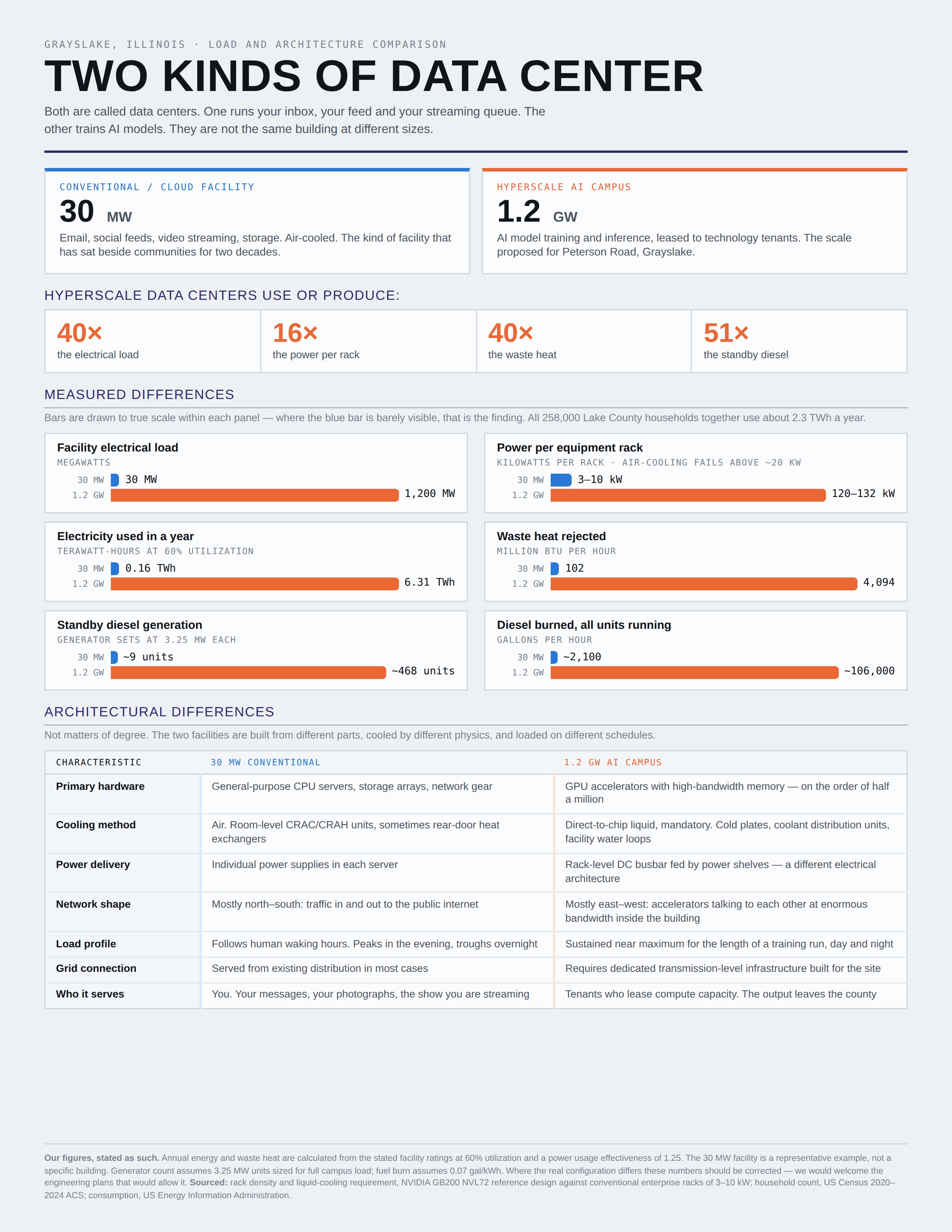
Both are called data centers. One runs your inbox, your feed and your streaming queue. The other trains AI models. They are not the same building at different sizes — they differ in electrical load, in cooling, in the hardware inside, and in what they require of the grid and of the neighborhood.
Conventional / cloud facility
Email, social feeds, video streaming, business applications, storage. The kind of facility that has sat beside communities for two decades.
Hyperscale AI campus
Training and inference for AI models, leased to technology tenants. The scale proposed for Peterson Road, Grayslake.
Bars are drawn to true scale within each panel. Where the blue bar is barely visible, that is the finding, not a rendering fault.
Megawatts
Forty conventional facilities would fit inside the proposed load.
Kilowatts per rack
Above roughly 20 kW a rack cannot be air-cooled. This is the line that changes the building.
Terawatt-hours, at 60% utilization
All 258,000 Lake County households together use about 2.3 TWh a year.
Million BTU per hour
Essentially all electricity drawn leaves as heat. It has to go somewhere.
Generator sets at 3.25 MW each
Sized for the full campus load with redundancy.
Gallons per hour
Roughly twelve tanker loads an hour during a sustained grid event.
These are not matters of degree. The two facilities are built from different parts, cooled by different physics, and loaded on different schedules.
| Characteristic | 30 MW conventional | 1.2 GW AI campus |
|---|---|---|
| Primary hardware | General-purpose CPU servers, storage arrays, network gear | GPU accelerators with high-bandwidth memory — on the order of half a million of them |
| Cooling method | Air. Room-level CRAC/CRAH units, sometimes rear-door heat exchangers | Direct-to-chip liquid, mandatory. Cold plates, coolant distribution units, facility water loops |
| Power delivery | Individual power supplies in each server | Rack-level DC busbar fed by power shelves — a different electrical architecture |
| Network shape | Mostly north–south: traffic in and out to the public internet | Mostly east–west: accelerators talking to each other at enormous bandwidth inside the building |
| Load profile | Follows human waking hours. Peaks in the evening, troughs overnight | Sustained near maximum for the length of a training run, day and night |
| Grid connection | Served from existing distribution in most cases | Requires dedicated transmission-level infrastructure built for the site |
| Who it serves | You. Your messages, your photographs, the show you are streaming | Tenants who lease compute capacity. The output leaves the county |
The facility proposed for Grayslake is forty times the load, sixteen times the rack density, and built from parts the older kind of data center does not contain. Read the facts · Download this as a flyer
Our figures, stated as such. Rack counts, annual energy and waste heat are calculated from the stated facility ratings at 60% utilization and a power usage effectiveness of 1.25. The 30 MW conventional facility is a representative example, not a specific building. Generator count assumes 3.25 MW units sized for full campus load; fuel burn assumes 0.07 gallons per kilowatt-hour. Where the real configuration differs, these numbers should be corrected — we would welcome the engineering plans that would allow it.
Sourced figures. Rack power density and the liquid-cooling requirement: NVIDIA GB200 NVL72 reference design (approximately 120 kW; OEM implementations to 132 kW) against conventional enterprise racks of 3–10 kW. Lake County household count: US Census Bureau, 2020–2024 American Community Survey. Illinois residential electricity consumption: US Energy Information Administration.