 The T5 Data Center
The T5 Grayslake Chicago IV Campus Facts
Location
Along Peterson Rd, between Alleghany Rd and Route 83. Approximately .25 miles from Saddlebrook Farms and Alleghany Park, and approximately 1 mile from Ivanhoe Village, an 800-acre mixed-use master-planned community on Wirtz family farmland in Mundelein.
Footprint
Total land area: 472 acres — the 2nd largest facility of this kind in Illinois. The Village’s September 2026 FAQ mailer says the “latest plans expect 6,750,000 square feet of building space across 11 different buildings.” According to the Chicago Tribune could be as large as 20 buildings and 10 million square feet. T5 says only Buildings 1 and 2 have been designed so far, and calls the campus layout “still speculative.”
Approvals
Approved by the Grayslake Village Board in September 2024 and May 2025, including zoning. The first building permit, for an 800,000-square-foot building, was issued September 1, 2026. Grayslake has denied FOIA requests for engineering plans, citing litigation. T5 says it holds an Illinois EPA permit to construct its diesel emergency generators (as a non-major source) and a U.S. Army Corps of Engineers Section 404 permit for 0.3 acres of wetland disturbance for road and utility crossings.
Timeline
60 MW data center online by Q4 2027. Full buildout would occur over the next 7-10 years. T5 says each building takes about 2 years to build.
Scale
T5 has secured 1.55 gigawatts of power from ComEd. According to T5 CEO, they could build 20 two-story 60-megawatt data centers or several larger-footprint, 100 to 200 megawatt AI factory buildings. The campus will also include its own ComEd-built substation. The original 2024 plan was 480 MW. T5’s FAQ says Building 1 will draw 300 MW and Building 2 150 MW (total utility load), or 450 MW for the first two buildings. This represents almost 10X the capacity of the largest building T5 has built to date (Norhlake, 37 MW).
Community Impacts
Nearby residents will very likely experience increased traffic and noise during construction, and potential environmental impacts of the data center operation including decreased air quality, low-frequency noise, urban heat island effects, and increased stormwater runoff to surrounding areas. Many of the environmental impacts will be dealt with only as violations due to the inability of regulatory agencies to monitor proactively.
Revenue Projections
The Village of Grayslake estimates $1.4B in property tax revenue over 20 years. T5 says the Village granted no incentives and that property taxes will be paid in full with no abatement. At the state level, T5@Chicago IV, LP (Grayslake) is already certified under the Illinois Data Center Investment Program, which exempts equipment from sales and use tax. The state’s 2025 annual report lists a $250 million investment commitment and an estimated $15.6 million in tax benefits. The exemption at full buildout has not been disclosed. Any Lake County incentives are unknown.
Job Creation
The Village of Grayslake estimates 750-1000 construction jobs per year during construction and 1200-1600 operations jobs once built. The Village does not claim those operations jobs are local. T5’s FAQ says each building creates 800–1,200 construction jobs over its roughly 2-year build, and 100–150 permanent workers per building once complete, a count that includes its tenants’ (“customer”) employees. T5’s state tax-exemption certification lists only 20 new jobs.
T5 AND VILLAGE PUBLIC CLAIMS
A closer look at specific claims from T5 and the Village of Grayslake FAQ, side by side with what each one leaves out. Every quotation is taken verbatim from T5’s website or the Village’s official FAQ. Cards rotate automatically — use Pause, the arrows, or the dots to control them, or click any card to view it larger. For our analysis of the rhetorical techniques in these communications, and how each one can leave a misleading impression, see this summary.
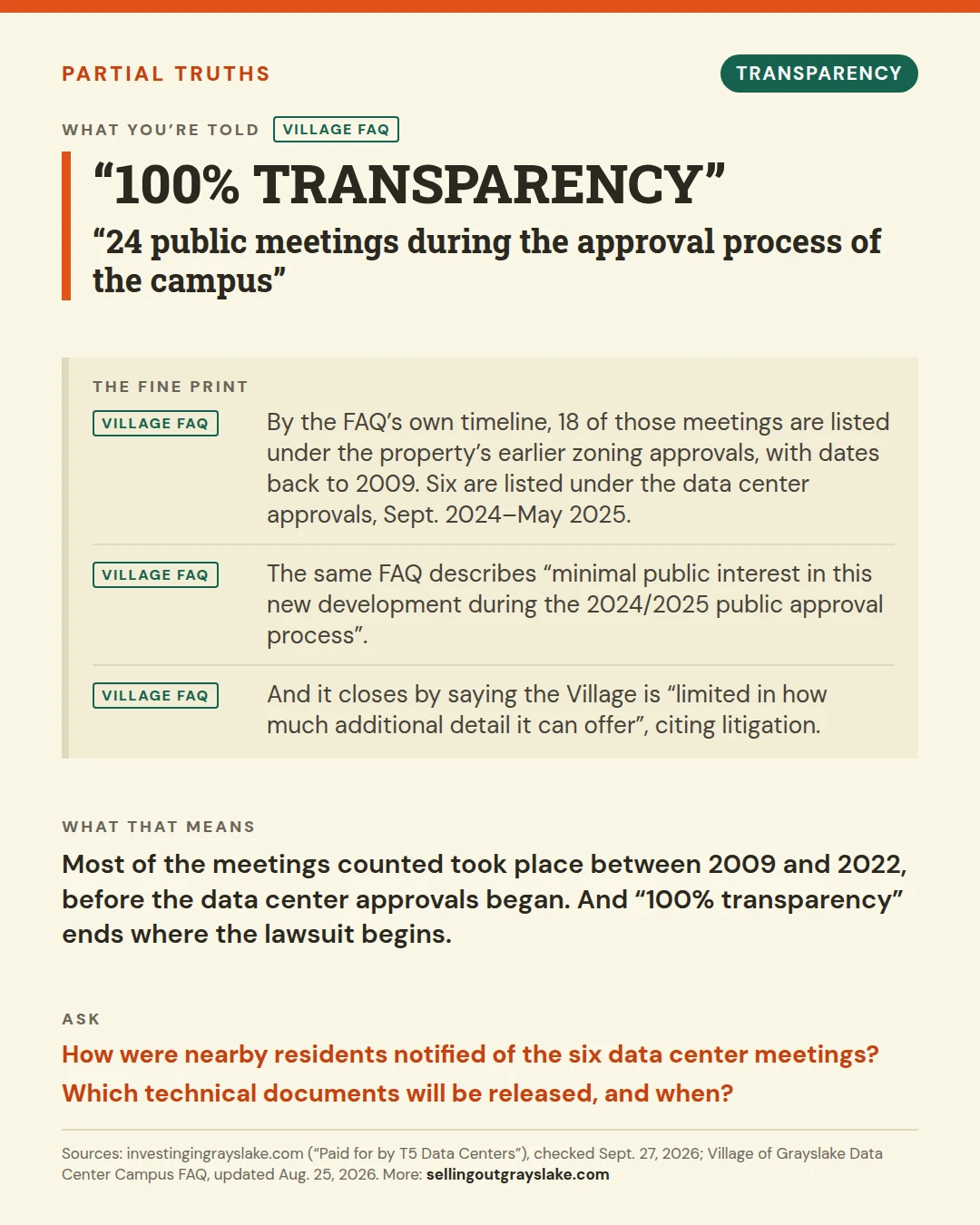
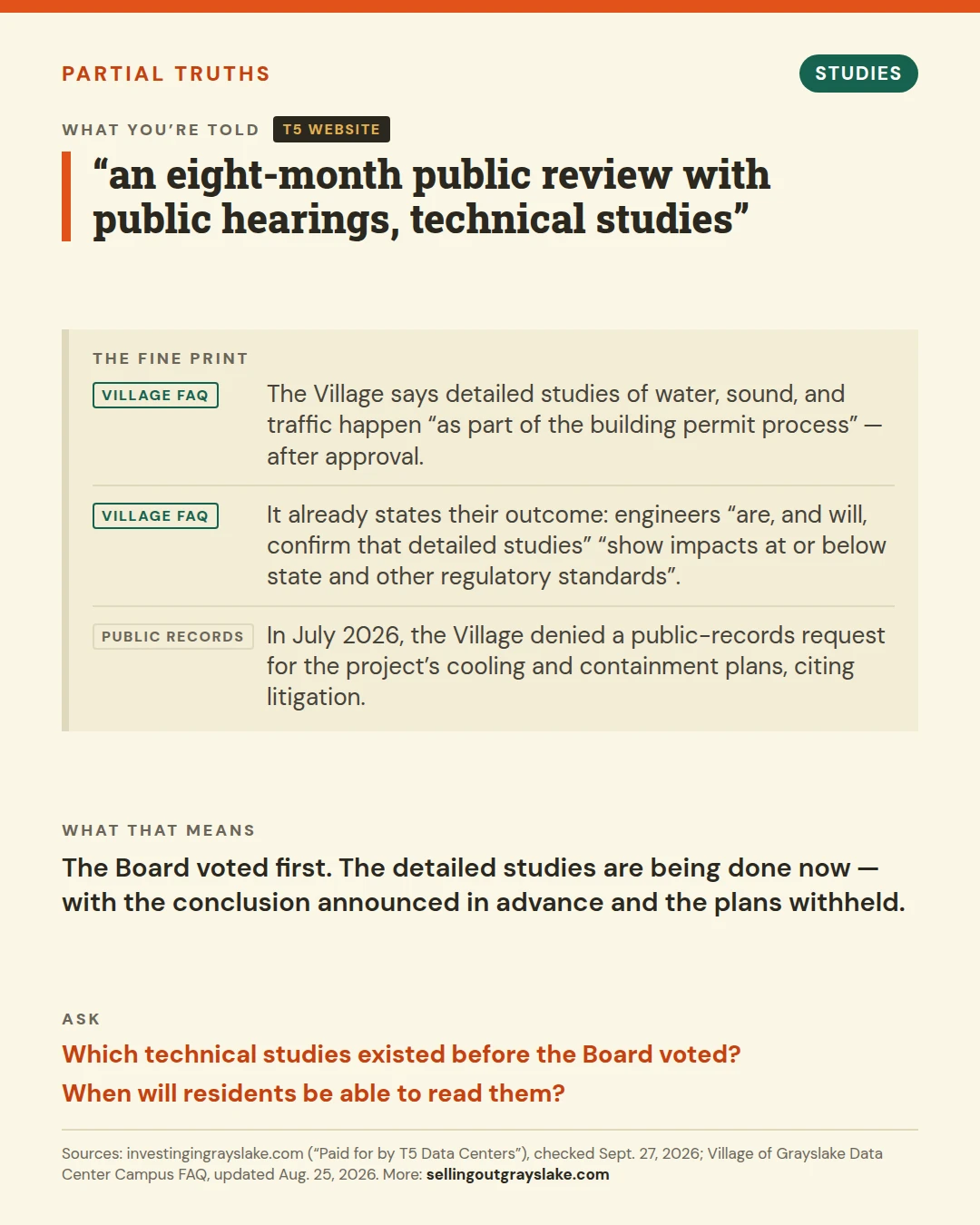
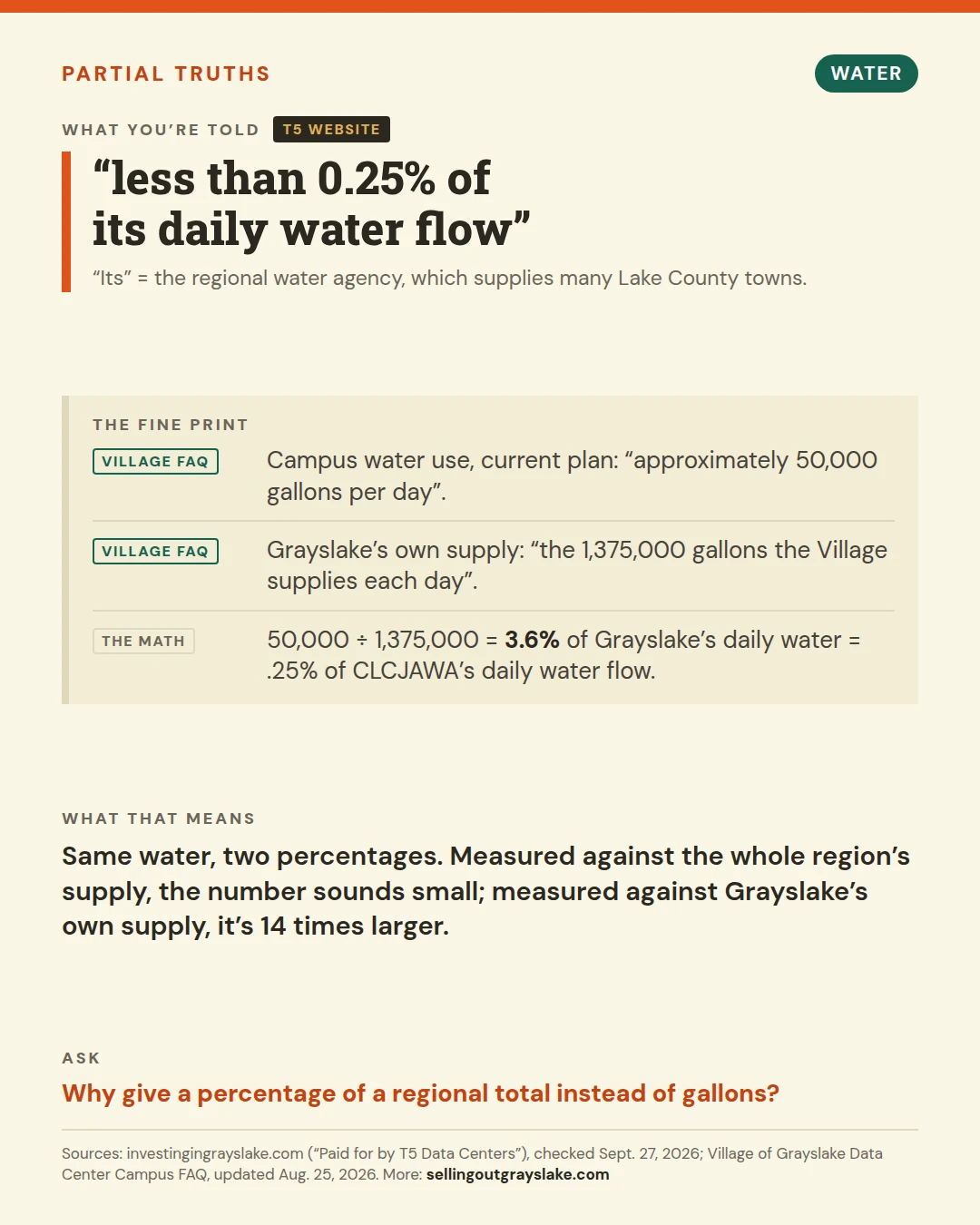
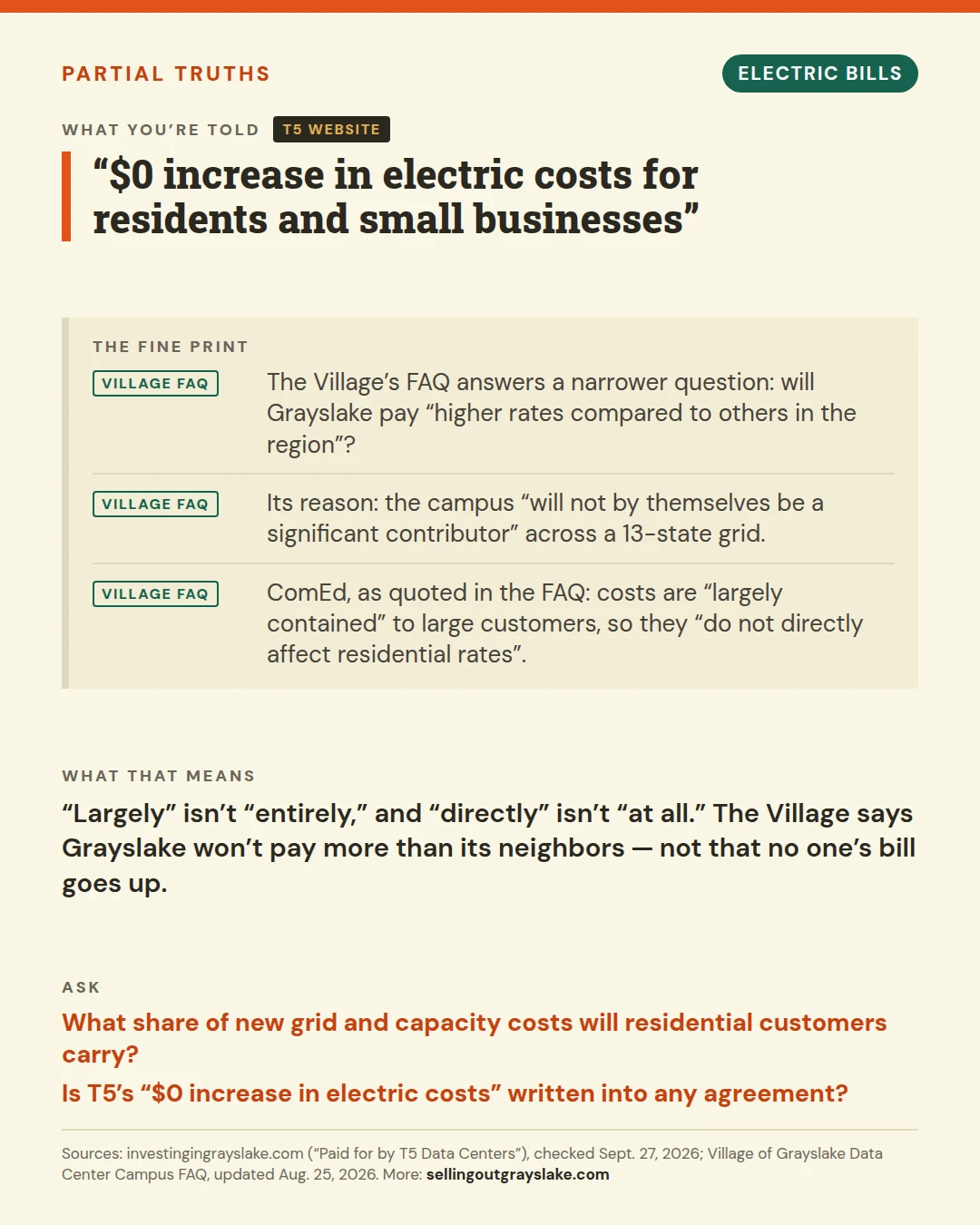
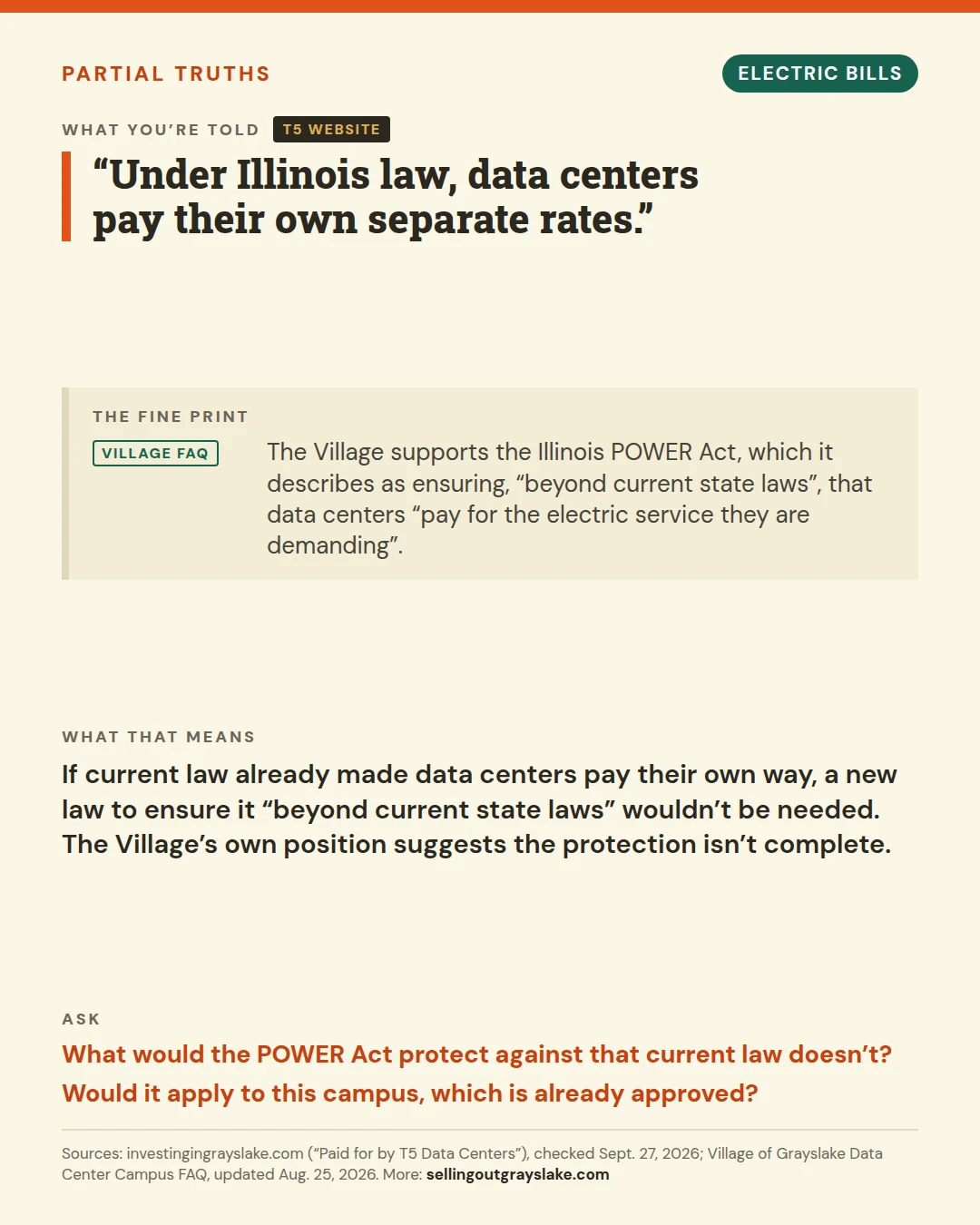
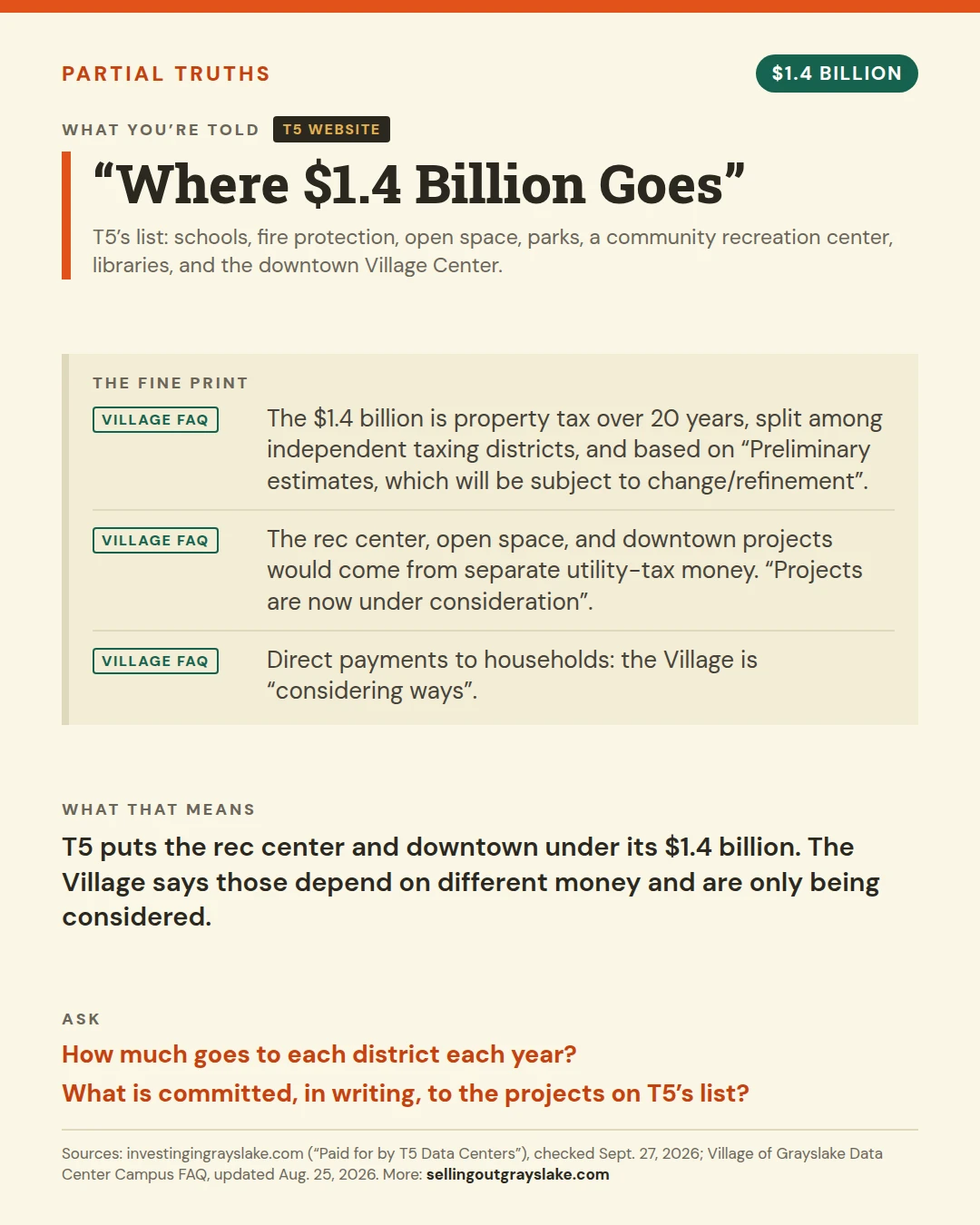
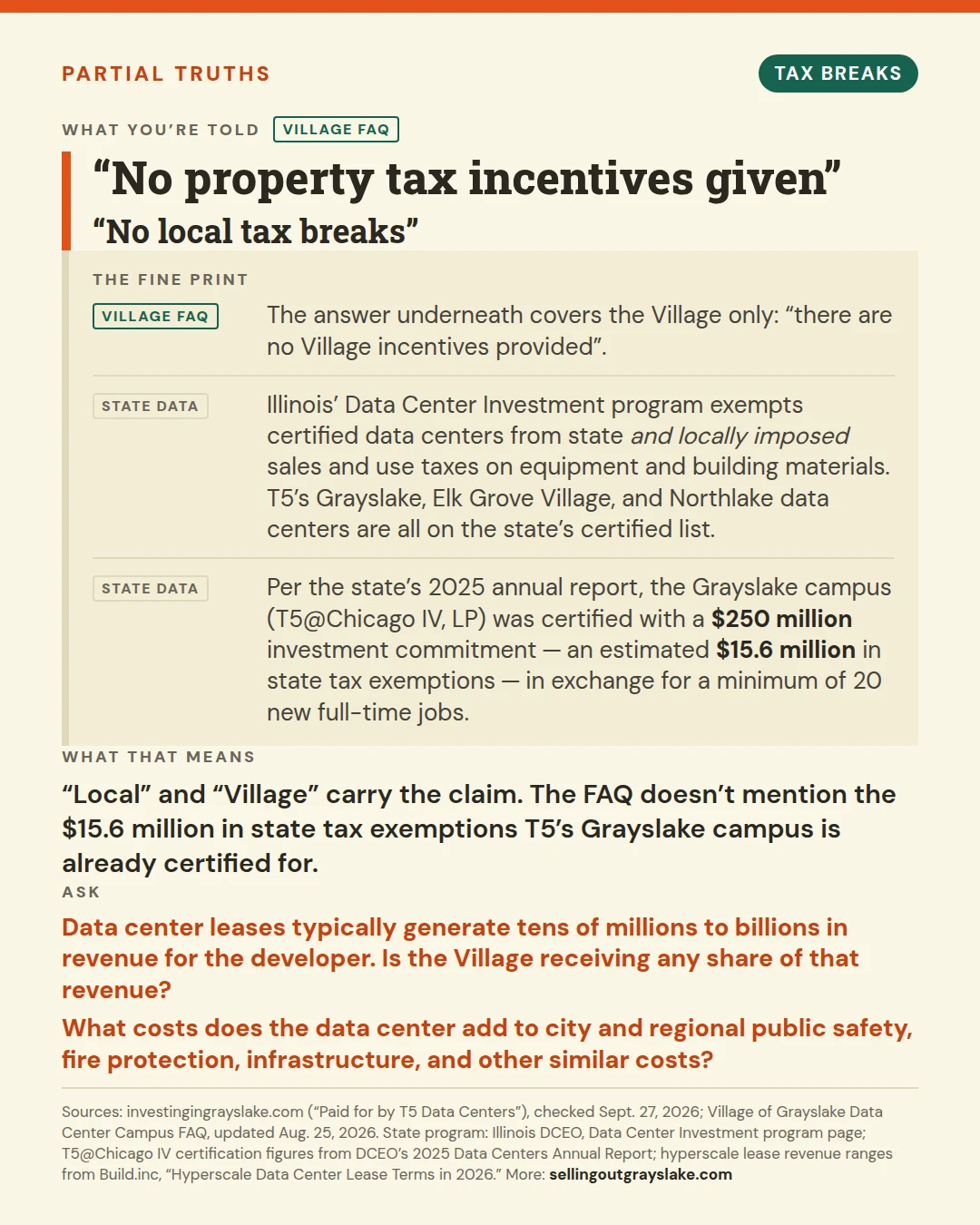
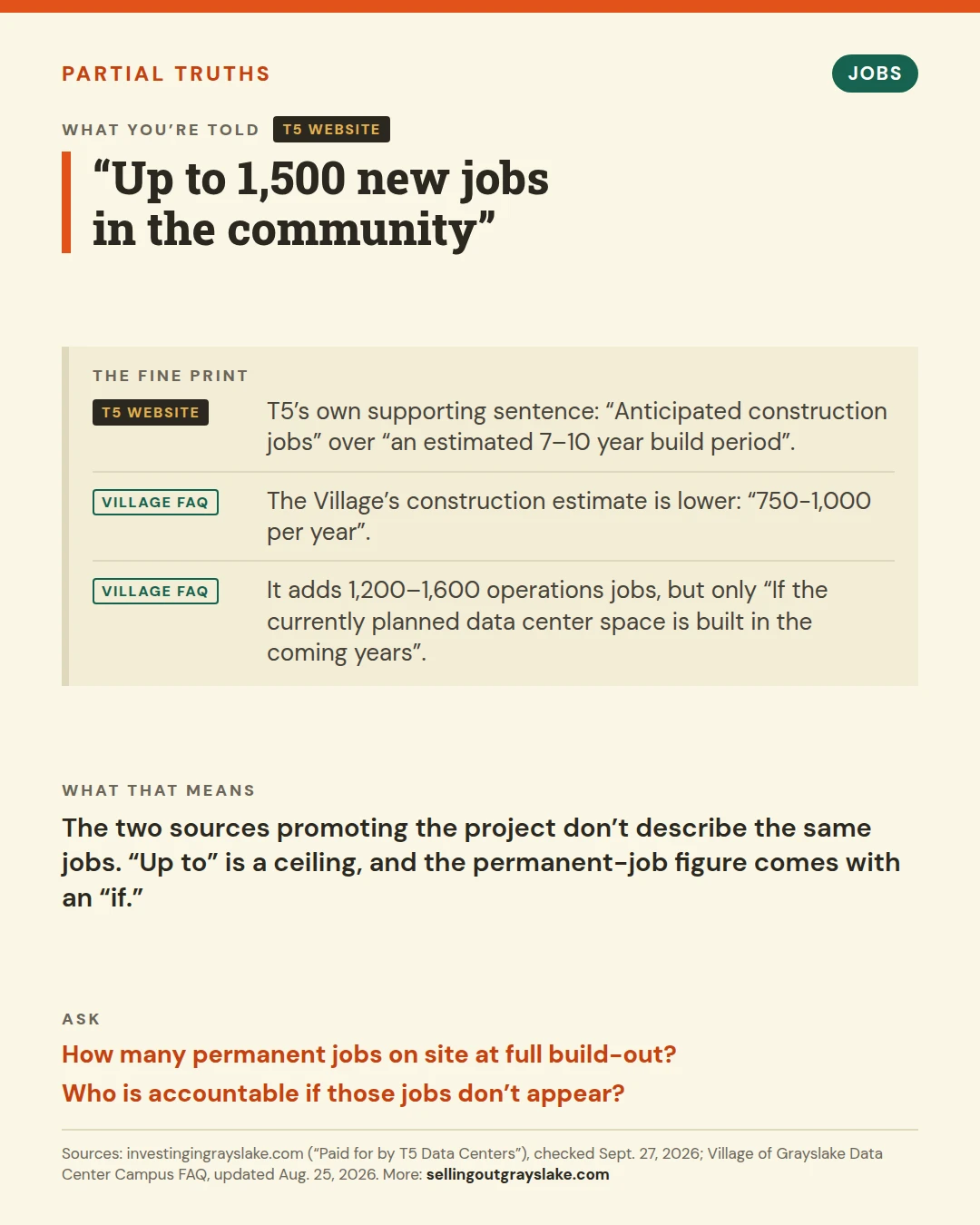
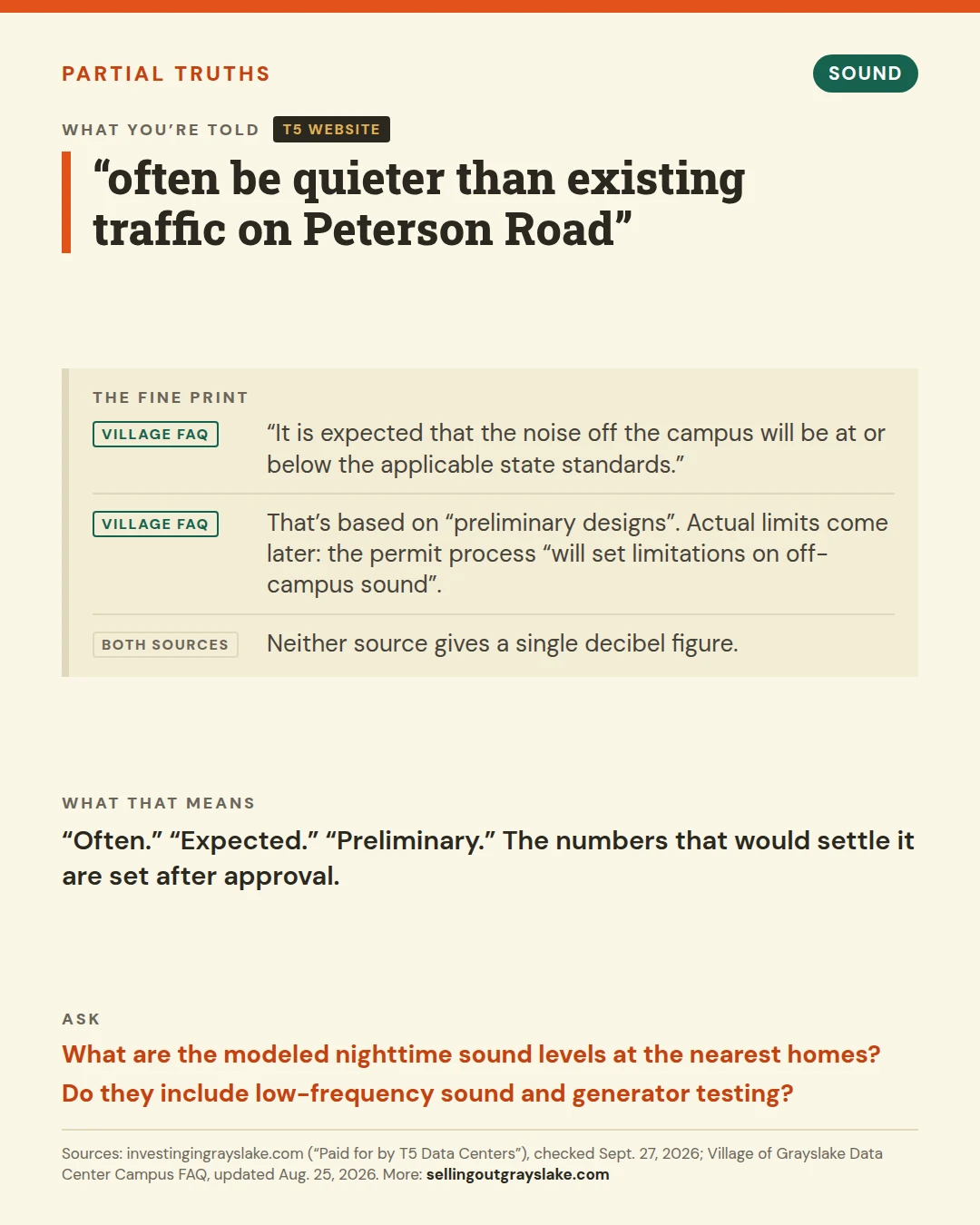
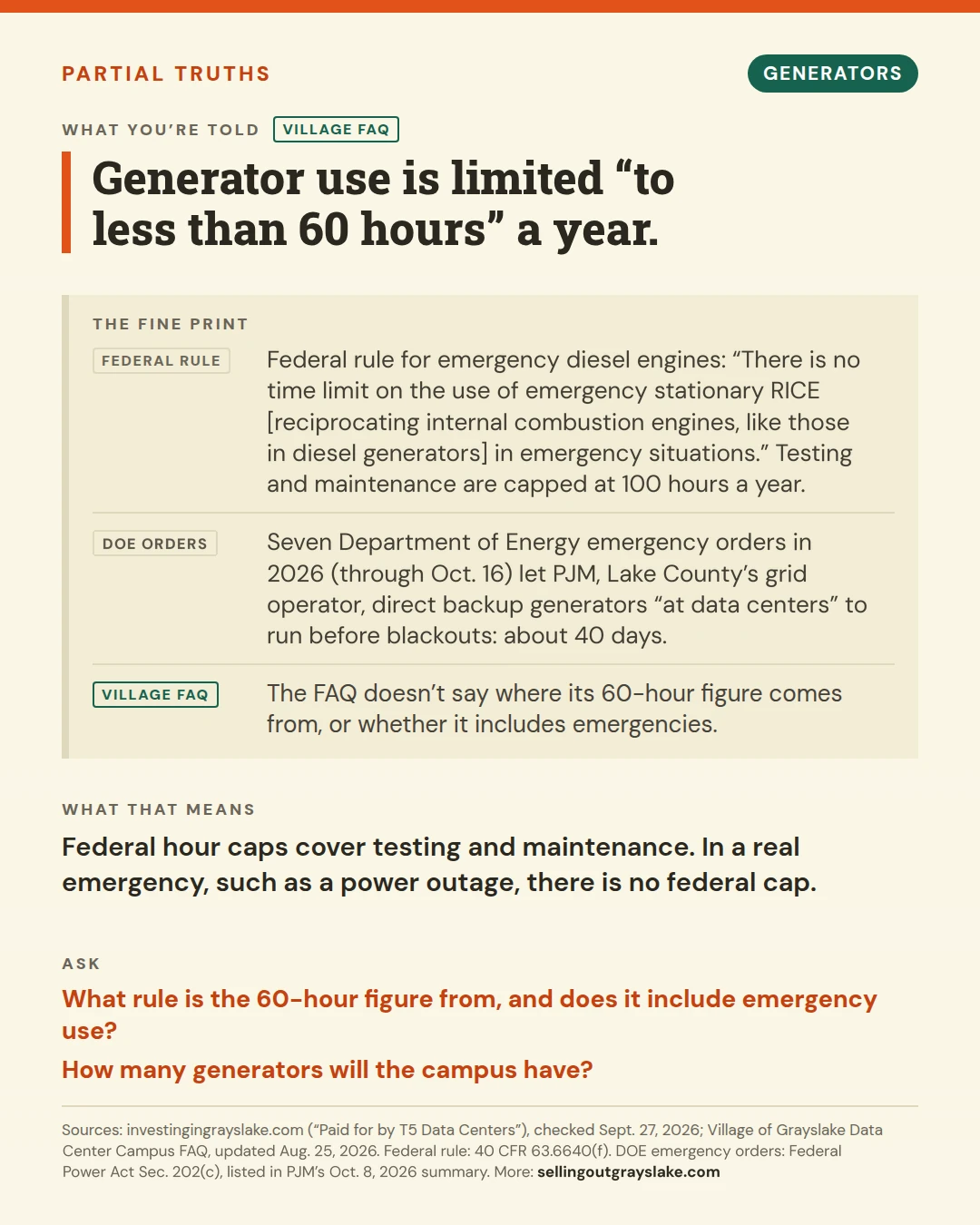
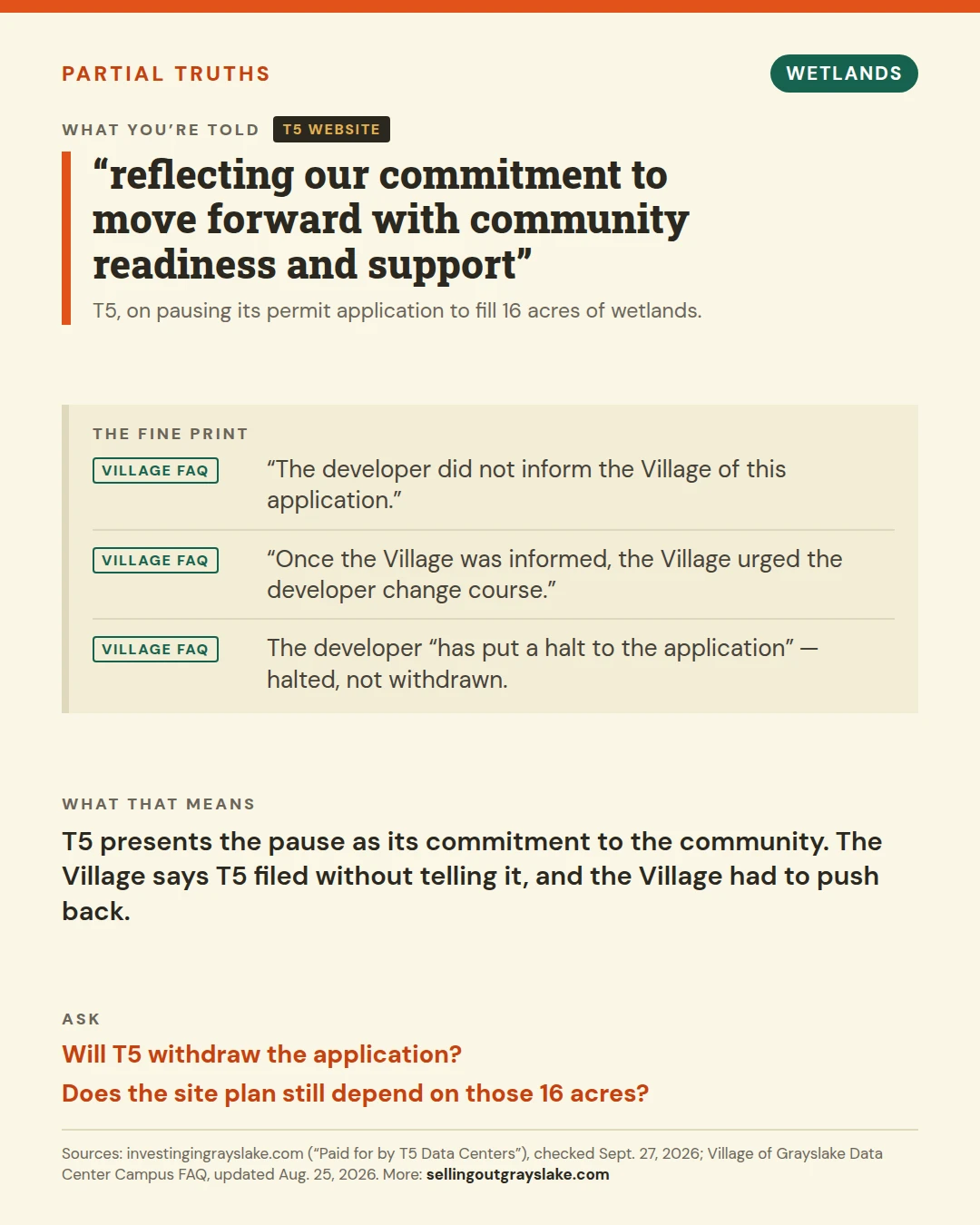
Or view these cards as one PDF.
Partial and Contested Facts
Little is known about the design and construction of the buildings, and in particular what environmental safeguards are planned. All of the following statements of fact are from the Village of Grayslake FAQ and public statements from Grayslake officials.
-
"the data centers that will be built here ...will not result in overall impacts greater than typical light industrial/warehouse/logistics uses that are present in the Peterson Road corridor"
-
Comment: According to Village of Grayslake Zoning Ordinance, Chapter 17: "LIMITED INDUSTRIAL (LI): This industrial zone is established to provide areas for industrial, office, and administrative uses, having few, if any, adverse effects on neighboring properties."
Data centers typically have diesel backup generator capacity capable of supplying the entire electrical load of the campus. T5’s FAQ says Building 1 will have 6 diesel emergency generators and Building 2 will have 5. At 300 MW and 150 MW, that works out to roughly 50 MW and 30 MW per generator, while standby diesel sets sold to data centers are typically 2.5 to 3.25 MW each; at those capacities, assuming 3.25 MW generators, 139 diesel generators would normally be needed to back up 450 MW with no spare capacity. T5 has not disclosed generator ratings or what share of the load they carry. T5’s stated testing schedule (5 minutes weekly, 30 minutes monthly, one 4-hour annual test) comes to about 14 hours per generator per year. Testing produces carbon monoxide and other pollutants as well as diesel odor. Neighbors typically complain of strong diesel fumes that cause physical symptoms, including nose and throat irritation, coughing, and headaches. Diesel exhaust is detectable by smell at concentrations far below any health threshold, making odor complaints common near similar facilities.
Hyperscale data centers also use large lithium battery systems, either Battery Energy Storage Systems (BESS) or uninterruptible power supply (UPS) batteries, that come online in fractions of a second when a fluctuation or outage is detected and carry the load until the diesel generators start. T5 says no BESS is designed for Buildings 1 or 2, but its own list of studies includes a “UPS Batteries Analysis,” and a data center’s UPS is itself a battery system. T5 has not disclosed the chemistry or capacity. Lithium batteries can undergo thermal runaway, a situation in which a battery overheats and causes a fire that creates its own oxygen and can’t be put out with water, so it must be allowed to burn. Fires of this kind require enhanced HAZMAT response, to say nothing of the potential environmental pollution a lithium fire will cause. In January 2025 in Moss Landing, CA, a fire broke out in Vistra's 300 MW BESS plant. Firefighters used a "monitor and contain" approach and allowed the fire to burn itself out. The police issued evacuation orders and closed two nearby roads and a highway, and the local school district closed all schools for a day. Researchers later estimated that the fire deposited 55,000 pounds of toxic heavy metals in area wetlands.
The village FAQ says "very little village costs will be incurred"for municipal services, which is true, because HAZMAT fires are handled by a regional agency (MABAS), so firefighting training and equipment for large-scale HAZMAT battery fires will be borne by the entire area, not just Grayslake. T5 says the design was reviewed by the Grayslake Fire Department but has not said what fire-suppression plan was reviewed.
-
-
"estimated $18B in private investment in the local economy".
-
Comment: T5 will use local contractors for some things like concrete and construction equipment that it cannot easily supply itself, but that spending will be temporary and a small fraction of the $18 billion. The majority of the $18 billion in spending, if T5 actually even spends that much, will be in capital assets T5 owns (property, plant, and equipment), not the local economy. A corporation that can afford $18 billion in construction can easily absorb the cost of ignoring zoning ordinances, regulations, and even laws.
For comparison, T5’s state tax-exemption certification for the Grayslake campus lists an investment commitment of $250 million.
-
-
"Q: Will there be discharges from these facilities that could impact area groundwater? A: No. All...discharges from these facilities will be into the sanitary
sewer system"
-
Comment: T5’s FAQ now says the closed loop is never drained once filled, that spills during server swaps are small enough to wipe up with a rag, and that leak detection and spill containment are in place wherever chilled-water pipes run inside each data center. But pumps, valves and chillers are repaired and replaced over decades; when a section is opened, where does the fluid go? T5 says the loop contains no PFAS but has not disclosed which corrosion inhibitors, biocides or other additives it does contain. Biocides and other chemical additives entering the stormwater drainage system from leaks can kill wildlife, and water treated by biocides can cause rare bacteria not killed by the biocide to be released into the environment (Cheyenne, WY this year). T5 describes stormwater controls only as “designed to code,” with no permit named, and has described no groundwater monitoring plan and no leak detection for outdoor piping to the dry coolers. The Village’s September 2026 FAQ mailer confirms that outdoor piping exists: it says heat tape, not glycol, will protect “the chilled water system” from freezing outside.
-
-
Water usage: No more than 50,000 gallons per day.
-
Comment: The Village FAQ says this water will be for “breakrooms/restrooms.” T5’s FAQ gives average daily use of 2,675 gallons for Building 1 and 2,150 gallons for Building 2, which includes humidity make-up water for the data halls, which is not an office use. T5 says the cooling is a closed loop with dry (air-cooled) heat rejection and uses no other water. Those are annual averages; T5 has not given a hottest-day figure. The larger number is the one-time fill: T5 says Building 1 needs 2,750,000 gallons and Building 2 1,250,000 gallons, 4 million gallons for two of the campus’s planned 11 buildings. T5 has not disclosed the full buildout fill volume or how many fill events there will be. If the system is truly closed loop, daily use is modest; the open questions are the total fill volume and the peak-day draw.
-
-
Backup diesel generators won't run outside of 60 hours of testing.
-
Comment: T5’s FAQ gives a testing schedule of 5 minutes weekly, 30 minutes monthly and one 4-hour annual test, all in daytime. That is about 14 hours per generator per year, and close to 5 hours in the month with the annual test, although T5 also says testing is “less than one hour each month.” Testing limits apply to testing only; federal rules place no hour limit on emergency operation. In times of shortage or grid stress, PJM asks customers who are capable of generating electricty to generate their own. Data centers cannot tolerate power outages, so the diesel generators will run whenever there is an insufficient supply of electricity to Chicago IV for more than a few seconds or when PJM requests self-generation due to grid stress. T5 says it will not use generators for "primary power", but does that also mean that they will not use them during a grid emergency?
They may have no choice. In 2026 the U.S. Department of Energy has issued at least seven emergency orders under Section 202(c) of the Federal Power Act authorizing PJM, which runs the grid serving Lake County, to direct backup generators to run “as a last resort” before rolling blackouts: January 26–February 2, May 18–20, June 30–July 7, July 14–21, September 1–8, September 17–18 and October 13–16, about 40 days in all. The orders say PJM intends to use backup generation “at data centers” and other large commercial and industrial sites, and that during these runs environmental rules apply only “to the maximum extent practicable.” Emergency runs are not counted against testing-hour limits. The most recent order is No. 202-26-50; the others are listed in PJM’s October 2026 summary.
-
-
"it is currently estimated that between 1200 and 1600 jobs will be created."
-
Comment: Actual typical on-site employment for other hyperscale data centers is 20 to 40 on-site workers per 100 MW. In this case, it would more likely be 240-480 on-site workers for the full 1.2GW buildout. T5’s own FAQ gives 100–150 permanent workers per building, including its tenants’ employees, and its state tax-exemption certification lists only 20 new jobs.
-
-
"It is expected that noise off the campus will be at or below the applicable state standards."
-
Comment: While possibly true of audible sound, there are no state or federal standards for infrasound, which is sound below the 20 Hz level of human hearing. Cooling systems such as will be used at T5 Chicago IV are capable of creating infrasound under certain conditions from data center cooling fans, HVAC systems, backup generators, and power transformers. A facility can pass a dBA limit comfortably while putting substantial low-frequency energy into the environment. While the effects of infrasound on the environment are not well understood, some studies have shown that infrasound can have detrimental health effects on humans and wildlife, including symptoms like nausea, dizziness, physical sensations of vibration, ear pressure, fatigue, sleep disruption, and psychological distress or unease. Infrasound can travel easily over long distances and through physical obstacles, interacting with buildings, geological features, or ground structures to create secondary mechanical tremors that affect local living conditions.
T5’s FAQ says the campus is designed to meet 44 dBA at the property line, the Illinois nighttime limit, and gives only that single A-weighted figure. A-weighting discounts low frequencies heavily (about 26 dB at 63 Hz), so a low hum can be plainly audible while the dBA figure looks quiet. The Illinois rule T5 cites, 35 Ill. Adm. Code 901.102(b), sets nighttime limits band by band in unweighted decibels starting at 31.5 Hz, and Section 901.106 separately prohibits prominent discrete tones such as transformer hum. T5 has not published its acoustical study, its band-by-band results, or the existing sound levels its consultant measured.
Data centers run and create noise 24/7. Even when operating within allowable dBA noise levels, the constant sound of a data center creates a cognitive load. Normal noise tolerance depends on getting quiet recovery periods. With round-the-clock industrial noise there's no such recovery window, so the load shows up as chronic mental fatigue, degraded sleep (which itself lowers next-day cognitive capacity before the noise exposure even starts again), and the kind of "can't concentrate," "can't relax outside" complaints of those already living near data centers.
-
-
"facility equipment is to be spring mounted so there are no anticipated off-site vibrations."
-
Comment: Infrasound is caused by low-frequency pressure fluctuations and mechanical vibrations generated by fan blade rotation speed, aerodynamic turbulence, and structural resonance. Spings address structural resonance but do not address the full problem.
-
-
"Grayslake residents will pay nothing for the infrastructure to supply electricity to the data center"
-
Comment: ComEd is a regulated monopoly. The Illinois Commerce Commission (ICC) sets the rates that ComEd can charge its customers, and those rates are designed to recover the costs of infrastructure investments, including those made to support large-scale data centers like T5 Chicago IV. Therefore, while Grayslake residents may not see a direct line item on their bills for the data center's electricity supply, they will ultimately bear the cost through higher utility rates.
T5’s FAQ says T5 will pay for the 345 kV ComEd substation serving the campus and the distribution lines from it, but gives no dollar figure and says nothing about transmission or PJM network upgrades beyond the site, the costs most likely to be spread across ratepayers. Asked whether its rate class is higher or lower than residential rates, T5 did not say. Beyond dedicated infrastructure, its commitment to pay its “full share” rests on the same state rules that apply to every customer, not on an agreement specific to T5.
The Village’s September 2026 FAQ mailer promises more than T5 does: “Developer pays for all electric infrastructure needed.” Citing ComEd, it also says the cost of upgrades for large projects is only “largely contained” to the large-customer rate class, while T5 says that class captures “all costs.”
-
-
"Recently, the campus developer has put a halt to the application related to these 16 acres of wetlands."
-
Comment: The Village’s September 2026 FAQ mailer says the developer “did not inform the Village of this application” and that the Village “urged the developer [to] change course.” T5 tells it differently: its FAQ says the application was “voluntarily withdrawn” “commensurate with community feedback,” while T5’s home page and CEO letter say “indefinitely suspended.” Halted, suspended or withdrawn are not the same thing: a suspended application can be revived; a withdrawn one has to be refiled. Only the U.S. Army Corps of Engineers record can settle which it is, and none has been published. The Village’s mailer also does not mention T5’s separate 0.3-acre Army Corps permit for road and utility crossings.
-
For a discussion of general hyperscale data center myths, see this flyer.
The Lawsuit
A lawsuit was filed on July 31, 2026, in the Lake County Circuit Court seeking to block and invalidate approvals for the massive 472-acre T5 @ Chicago IV data center campus planned in Grayslake, Illinois.The lawsuit was filed by a group called the Preservation of Community Well-Being Collective LLC along with nine local Lake County residents, naming the Village of Grayslake, developer T5 Data Centers, and landowner Alter Asset Management as defendants.
Key Claims in the Lawsuit
Zoning Issues: The complaint alleges that Grayslake approved the project despite the village's zoning code having no specific category or allowance for data centers.
Open Meetings Act Violations: Plaintiffs claim village officials violated the Illinois Open Meetings Act by conducting deliberations, closed sessions, and negotiations regarding the development outside public view.
Due Process Concerns: The suit argues that the approvals granted between September 2024 and May 2025 lacked adequate public disclosure and process, noting that key zoning items moved through public hearings rapidly with little room for public comment.
Project Scope: The proposed campus in the Cornerstone business park is slated to exceed 10 million square feet and draw roughly 1.55 gigawatts of power, making it a development of unprecedented scale for Lake County, far exceeding its zoning as "light industrial".